
The Wrong Dystopia
Another Brave New World, Part 2 — We braced for Orwell's boot. The pacification arrived as convenience instead.

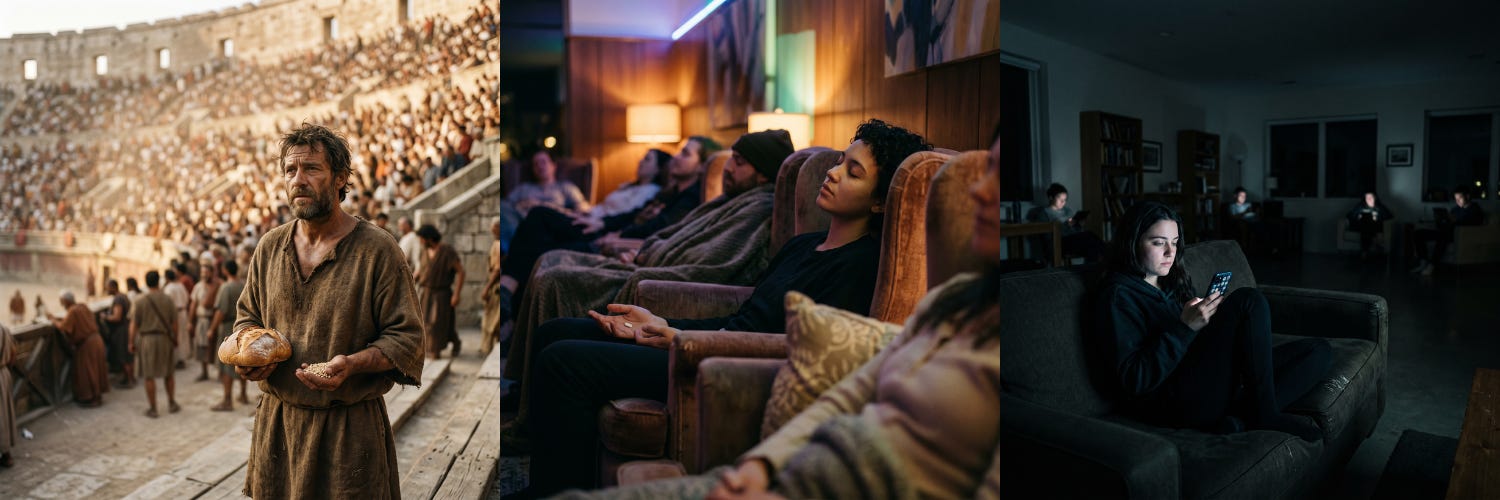
The Boot and the Feed
The dystopia we have been preparing for has a boot on its face. That is Orwell. The state watches. The state coerces. The state lies and tortures. Resistance is meaningful because the regime is meaningful. The hero in 1984 fails, but he fails in the act of trying.
The dystopia arriving has no boot. It has a feed and a transfer. The state is mostly absent. Coercion is unnecessary. People are not being forced into the new arrangement. They are being given things until the arrangement is no longer a question. The pressure that built into 20th century totalitarianism does not build because it is absorbed in advance.
This is a different issue and needs a different approach. The boot you can resist. The feed you scroll. The transfer you cash. The disquiet you cannot quite name. The slow disappearance of something you used to know about yourself, about the place you live, about what you and your neighbors are for.
The pattern has been named before, more than once. The first naming was older than the printing press. The second was a novel published seventeen years before 1984. The third is the one we are inside.
The First Naming: Bread and Circuses
The phrase comes from Juvenal, writing around 100 CE. Satire X. The Roman populace, he observed, had once concerned itself with politics. It had elected magistrates. It had debated policy. It had participated, in some form, in the project of the Republic. By Juvenal’s time, that engagement had collapsed. The populace cared about two things. Panem et circenses. Bread and circuses.
The phrase is sharp because the diagnosis is structural. Juvenal is not saying the populace was bribed. He is saying that the state had taken on the provision of two things: daily subsistence through the grain dole, and spectacle through public games. The populace had accepted the trade. The trade was not articulated as a trade. It did not need to be. The agency migrated. The provision arrived. Political participation withered without anyone deciding to give it up.
This is the mechanism worth understanding. Rome was not undone primarily by barbarians from outside. The empire that the barbarians eventually breached had already hollowed itself out from within. A citizenry that had traded participation for provision no longer had the muscles to defend the participation when it was needed. The political body had atrophied while the urban body had been kept fed and entertained.
The actors in this story are not villains. The emperors who maintained the grain dole were responding to genuine urban hardship. The politicians who funded the games were doing what successful politicians have always done. The populace was not foolish to prefer bread and games to faction and risk. Each step made sense. The cumulative drift did not require anyone to be malicious. It required only that nobody resist the convenience of the arrangement.
This is the first naming. The pattern is: a population that holds political power, a state that can afford to provide subsistence and entertainment, and a slow trade that nobody calls a trade. The result is a populace that retains the form of citizenship but loses its substance. Juvenal noticed it because he could see the gap between what the citizens had been and what they had become.
The Romans gave us the original vocabulary. The 20th century gave us the second.
The Second Naming: Soma and Feelies
The phrase comes from Aldous Huxley. Brave New World. Huxley was not predicting the boot. He was predicting something stranger. He was predicting a regime that needed no boot because the population had been engineered to prefer it.
The mechanisms in his world are now familiar. There is a drug called soma, distributed freely, which dissolves anxiety. There are immersive entertainments called feelies, which replace depth with stimulation. There is conditioning from before consciousness, which produces people who want exactly what their station permits them to want.
What Huxley saw is that none of this requires force. The citizens of his world are not oppressed in any sense they would recognize. They are happy. They do not miss what they have lost because they have been engineered not to know it ever existed. Their happiness is the control mechanism. The pleasure absorbs the pressure that would otherwise produce dissent.
The contrast Postman drew is worth keeping. Orwell’s anxiety was about losing access to the truth. Huxley’s anxiety was about losing the capacity to care about truth once enough pleasure was on offer. The first is a problem of suppression. The second is a problem of dissolution. The pleasure makes the truth feel unnecessary, and after a while, it feels beside the point.
This is the second naming. The pattern is the same as the Roman one. A population that holds something it does not realize it holds. A system that can afford to provide subsistence and pleasure at scale. A slow trade that nobody calls a trade. The result is a population that retains the form of personhood while losing the substance. Huxley noticed it because he could imagine the gap between what people had been and what they could become if the conveniences were comprehensive enough.
The Romans had bread and games. Huxley had soma and feelies. The pattern was the same in both centuries. The question is: what are we giving up in this one?
The Third Iteration
The pattern is now arriving. The vocabulary is different. The architecture is the same.
The transfer is UBI, proposed, partially piloted, and discussed as if its arrival is a matter of when, not whether. The feed is algorithmic, infinite, calibrated to whatever holds attention longest. The Roman state could afford grain and games for the urban population because the empire was wealthy. The modern state, along with the technology sector, can afford UBI and infinite content because the AI economy is generating wealth on a scale that has never existed before. The mechanism is the same as it was: subsistence plus spectacle, provided at scale, by a system that can afford the provision.
The contemporary version differs in one structural way. Roman games and Huxley’s feelies gathered citizens in shared experience. The algorithmic feed disperses them into individual streams. Collective recognition is harder than it was in either of the predecessors.
What the Provision Absorbs
What is being absorbed by the provision deserves naming.
There is a personal cost. For most people, work has never been only a source of income. Work provides what transfer payments cannot compensate for. Identity. Purpose. Social role. Daily rhythm. The structure that organizes a life. The unspoken understanding that the morning has a shape because there is something to do that matters to someone else. The slow accumulation of competence at something specific. The relationships that develop through shared work over time. The check covers the rent. It does not cover any of the rest of it. The check arrives in the mailbox of someone who used to be a designer, a paralegal, or a journeyman electrician and is no longer, and the disappearance of what they were is not on the ledger.
There is a civic cost. This is the most precise name for the Roman pattern. A citizenry that has traded participation for provision no longer has the muscles to defend the participation when it is needed. The civic body atrophies. The capacity for collective political action withers. The institutions that depended on engaged citizens become hollow. The voters still vote. The participant no longer participates in anything. The pressure that should have built against the trajectory does not build. The actors with the most influence over what comes next operate without the resistance that would otherwise check them. Wang Peng’s “maintaining order, not sharing wealth” applies at the civic register as well as the personal one. The order being maintained is not only the order of keeping the urban poor calm, but also the order of a political system whose citizens have ceased to function as citizens.
The pattern is the same. The medium is different. The Romans used grain and games. Huxley imagined soma and feelies. We are building UBI and recommendation feeds. The mechanism in each case is provision at scale, calibrated to absorb whatever pressure the citizenry might otherwise generate. The Romans saw it. Huxley imagined it. We are living inside the third iteration, and we have not yet named it because we have been preparing for the wrong dystopia.
Why the Pattern Recurs
The pattern recurs because it solves a real problem. Coercion is expensive and produces resistance. Pacification is cheaper and produces compliance. The Roman emperor who funded the grain dole had fewer riots than the emperor who let the urban poor go hungry. The Brave New World administrators needed no Stasi because soma was cheaper than the secret police. The AI economy needs no propaganda ministry because algorithmic feeds and a competent transfer payment can produce the same calm at a lower cost.
What is new is the capacity. Rome’s dole reached an urban population. Huxley’s regime was fictional. The AI economy is the first arrangement that could afford pacification at a planetary scale while generating the surplus that pays for it. The pattern has been waiting for it.
This is what makes the pattern dangerous in a way that the Orwellian dystopia is not. The Orwellian regime advertises itself. The boot is felt. The dissent is real because the oppression is real. The pacification regime does not advertise itself. The disappearance is not felt. What has been lost is the very capacity to notice the loss. The grain arrives, the feed scrolls. The check is deposited. The disquiet you cannot quite name turns out to be the only signal you were ever going to get.
Two millennia. Three iterations. One pattern.
The Alternative
There is an alternative. It is not nostalgia for work that no longer exists. It is the deliberate design of work that does not yet exist, organized so that humans and their machines preserve what the pacification dissolves.
The third iteration is the one that gets named, or it is the one that does not.
Next: Architecture or Soma